
Describe the finished sheet component
Send the part model, drawing and flat-pattern information if available. State sheet grade, temper, nominal thickness, grain direction where relevant, and any restrictions on material substitution. Identify holes, cut edges, bends, embossed features and the functional datums used by the assembly.
Review tooling against demand
Provide prototype, first-order and expected repeat quantities. Tooling cost and part price should be compared on the same volume assumptions, with ownership, maintenance and design-change terms stated separately. A complex formed component may need a different tool strategy from a simple blanked bracket.
Account for secondary operations
Confirm whether tapping, machining, deburring, coating, assembly or packaging is included. Specify burr direction and edge condition where they affect handling or mating parts. If a finish changes the dimensions or electrical contact, show treated and masked regions on the drawing.
Set the inspection boundary
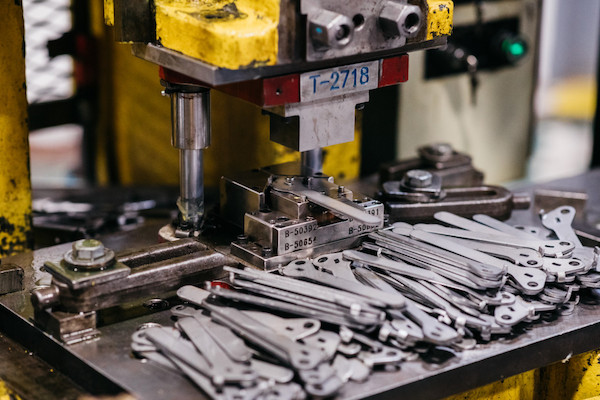
Mark critical dimensions and define how formed geometry will be checked in a free state or an assembly fixture, if the design requires it. Agree sampling, records and acceptance criteria. The presence of a press image does not establish a blanket tolerance or press capacity for a new part.
Project questions
Is stamping always cheaper than machining?
No. Tooling investment, annual demand, geometry, material use and required secondary work affect the comparison. Quote both routes against the same finished-part specification when the decision is open.
What files help evaluate a stamped part?
A current 3D model and drawing, material and thickness, quantity forecasts, finish, critical features and any flat-pattern or assembly constraints provide a useful starting package.