Identify the exact product configuration
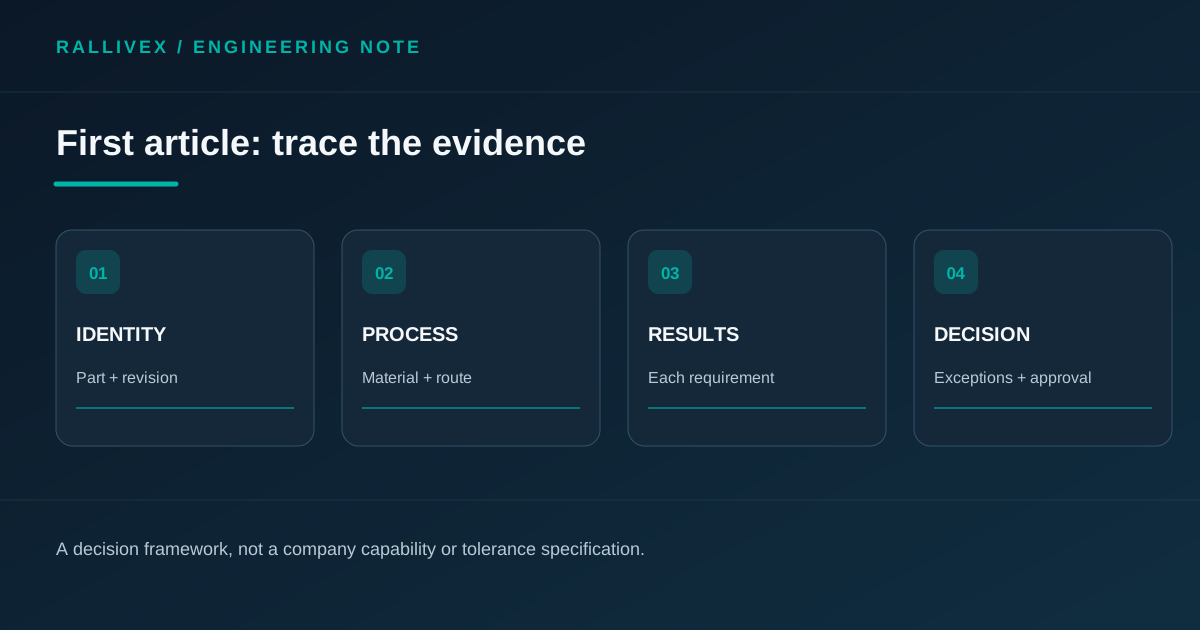
A first-article report should let a buyer tell which part was inspected, against which drawing and which revision. Include part number, description, drawing or model identifier, revision, sample quantity or serial identification where relevant, and the date of inspection. State the manufacturing route or process change that triggered the first article. An unlabelled spreadsheet of measurements cannot reliably establish that it belongs to the parts delivered.
IAQG describes 9102 as a standardized first-article process developed for aviation, space and defense, with possible use in other sectors where standardized FAI is needed. Its SCMH guidance separates part-number accountability, product accountability and characteristic verification in the 9102 forms. A buyer may use these headings as a checklist without claiming that every commercial machined part requires AS9102 or that RALLIVEX is certified to it.
Tie material and special processes to the sample
Identify the specified material form, grade and condition and the actual batch or certificate reference if required by the purchase order. Link coating, heat treatment or other special-process records to the inspected part when they affect acceptance. If inspection occurs before a required finish, label the result as an in-process measurement and define how finished dimensions will be verified.
Product accountability is not a stack of unrelated documents. A certificate with no batch link, or a plating report for a different revision, leaves a traceability gap. Agree the documentation package at RFQ stage so the supplier can preserve the needed identifiers through manufacture and shipment.
Report each required characteristic clearly
For every ballooned or otherwise identified drawing requirement, record the requirement, the actual result or an appropriate pass/fail statement, the unit and the inspection method where necessary to interpret the result. Include notes, geometric tolerances and specified features that are easy to overlook if the team measures only nominal dimensions. Reference calibrated equipment or method records when the contract requires them.
Distinguish a measured value from a derived or visual assessment, and identify the condition of inspection for flexible features. A report that lists only “OK” for every feature may not meet the buyer’s requested evidence. Conversely, do not invent a numeric reading for a requirement that is properly verified by an approved attribute method.
Record exceptions and approval
If a characteristic does not meet the released requirement, identify the exception and its disposition rather than silently replacing the nominal drawing value. Record who reviewed the report, whether customer approval is required, and which revision or corrective action applies. Retesting or rework needs a clear link to the final accepted sample.
A useful purchase-order note specifies the required report format, sample count, revision, material records and approval point before repeat production. Ask whether the customer wants an AS9102-format package, a simpler dimensional layout, or a project-specific submission. The document should answer a decision: does this identified production route produce the current part requirements, and what remains open?