
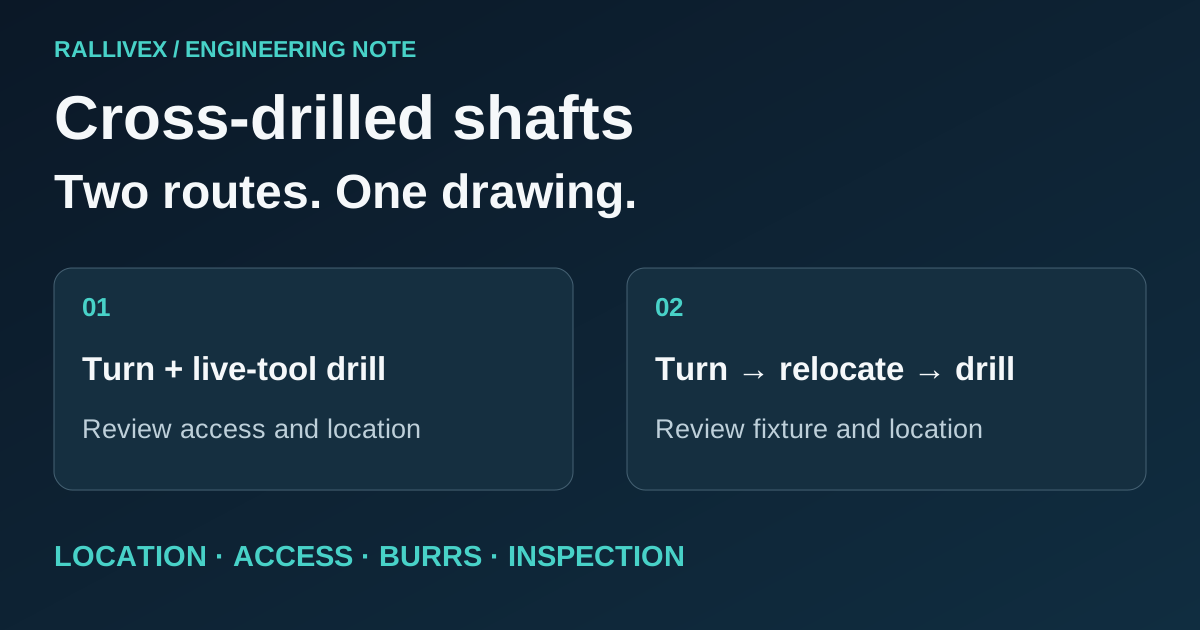
1. Choose from the feature relationships
Turn-mill is worth evaluating when a transverse hole must stay closely related to turned diameters, a shoulder or another oriented feature, and the proposed machine can reach it. Separate drilling is also a credible route when a dedicated fixture provides suitable location, support and tool access. The useful comparison is how each route produces and verifies the required geometry. Fewer setups can remove a relocation step, but the phrase ‘one setup’ does not prove that every drawing requirement will be met.
Start by distinguishing two tasks. A cross-hole through a solid shaft has an entry and an exit on curved external surfaces. A transverse hole that meets an existing axial bore also creates an internal intersection. The second task adds an internal edge that may be difficult to reach for deburring and inspection. A quotation should identify which condition applies, rather than treating both as a generic drilling operation.
2. Define axis, axial location and angular alignment
Show the hole's required relationship to the shaft axis and the face or shoulder used to establish its axial location. If it must align with a keyway, flat, slot or second hole, define that angular relationship too. A round diameter alone cannot identify a unique rotational orientation. Conversely, a fully rotationally symmetric component with one transverse hole may not need a separate angular reference. State the functional requirement on the drawing instead of adding a clocking tolerance without an assembly reason.

Consider a hypothetical shaft with a cross-hole for a retaining pin. If the hole only needs to sit at a defined distance from the end, that is a different locating problem from a shaft whose hole must align with a keyed hub. Send an assembly explanation when the drawing leaves that distinction unclear. In both cases, identify the controlled revision and the inspection reference features; the sketch below is a review aid, not a dimensioned manufacturing drawing.
3. Check what the proposed turn-mill setup actually reaches
Haas documentation distinguishes radial and axial live-tool configurations. Its lathe manual also describes C-axis spindle positioning and notes that operation depends on the workpiece and workholding configuration. For a radial cross-hole, ask the supplier to identify the driven-tool arrangement, how the spindle is positioned, and the available clearance around the chuck and part. These manufacturer examples explain the process; they do not establish which equipment is installed at RALLIVEX.
Keeping a component clamped can preserve the setup reference between turning and drilling. Still, check whether the opposite end, a hole near the jaws, or the final deburring operation requires another handling step. Ask where the part is supported during drilling and whether the chosen tool can reach without excessive extension. A route description that lists these steps is more useful than an unqualified promise to finish every feature in one operation.
4. Make the secondary fixture's locating method explicit
Carr Lane's fixture guidance separates locating the workpiece from holding it against cutting forces. Applied to a turned shaft, the review should identify the cylindrical locating feature, an axial stop where needed, and an angular locator when the drawing requires one. Vee blocks are one possible way to locate round workpieces. Carr Lane also explains that vee orientation affects how diameter variation influences the location relative to the cutting tool, so ‘held in a V-block’ is not a complete accuracy plan.
Request a simple setup sketch showing locating contacts, clamp positions and drilling access. Confirm which finished surfaces contact the fixture and which must remain free of clamping marks. When comparing a separate drilling route with turn-mill, include fixture preparation, part loading and the checks needed after relocation. Evaluate those costs and risks against the intended batch and repeat orders; neither route is automatically the lower-cost choice for every shaft.
5. Review hole entry, intersection and edge acceptance
Sandvik Coromant treats curved entry surfaces and intersecting holes as application-specific drilling conditions. Its guidance identifies chip evacuation, internal burrs and tool wear as concerns at a crossing, with different recommendations for different drill types. Specify the material condition and complete hole geometry so the machining review can use the relevant tooling guidance. Do not copy a feed reduction or hole sequence from one drill family into every process plan.
The purchase specification should explain the accepted edge condition and any surfaces that a deburring tool must preserve. If the transverse hole joins a fluid passage, identify the internal intersection that requires inspection and cleaning. Agree how that inaccessible edge will be checked; a satisfactory measurement at the external hole mouth does not demonstrate that the internal crossing is clean. Include this operation and its verification in both route proposals.
6. Request comparable route proposals and sample evidence
For a useful RFQ, provide the drawing and model when available, material and condition, quantity, expected repeat demand, hole-location requirements, angular relationships and edge acceptance. Ask each proposal to identify its machining and handling sequence, locating method, deburring scope and inspection evidence. Compare quotations against that same package. If you are still defining the part, an enquiry can start with a description of its function and the unresolved geometry; final manufacturing approval needs a controlled specification.
Before accepting a production route, agree what the sample inspection will demonstrate: the relevant turned features, hole size and location, any required angular alignment, and the specified edge condition. Keep results tied to the part revision and the proposed route. RALLIVEX's CNC turning service is the appropriate starting point for a cylindrical component enquiry; include any cross-drilling and inspection questions in the request so the whole part can be reviewed together.