
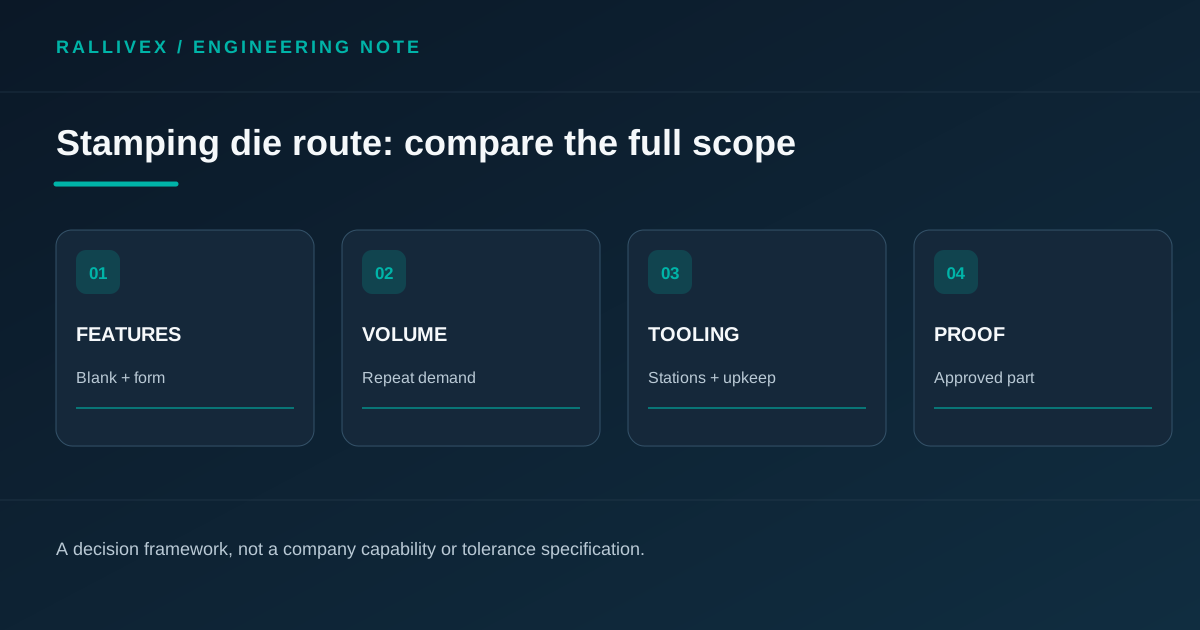
Define the finished part first
A die choice begins with the part drawing, material grade and temper, sheet thickness, bend sequence, edge condition and any secondary treatment. A simple blank with one critical opening can be very different from a formed terminal with several piercings and controlled orientation. Neither annual quantity nor the word “precision” selects a die by itself. Ask the toolmaker to identify which operations belong in the press and which remain outside it.
MISUMI describes blanking, piercing, trimming and forming as different stamping operations, and distinguishes progressive, compound and transfer tooling. Use that vocabulary to make bids comparable. A single-operation quote may cover one press operation while leaving subsequent operations to separate setups; a progressive quote may combine sequential stations while the strip advances. Request an operation map rather than assuming the two quotations deliver identical finished parts.
Review repeat demand and design stability
A progressive die can be attractive when a stable design is ordered repeatedly and the sequence of operations can run from fed strip. Its higher tooling complexity may be justified by the complete production program, not merely by the first purchase order. A simpler tool can be easier to justify for an uncertain geometry or modest demand, but several separate handling steps may increase recurring work.
Compare quotations at the same initial and annual quantities, with the same yield and inspection assumptions. Ask how a revision to a hole, bend or terminal shape would affect each tool. The true comparison includes engineering changes, maintenance, setup, material use, finishing and packaging as well as unit price. No universal crossover volume can be stated without the actual drawing and commercial terms.
Expose strip and part-handling assumptions
For a progressive concept, request a strip-layout review showing feed direction, carrier or pilot features, station sequence and how the finished part exits the die. Also identify grain direction where forming or performance makes it relevant. A complex strip layout is a design output to be checked, not proof that a supplier owns a particular press.
For a simpler route, map how blanks move between operations, what locates them on the next setup, and whether manual handling or secondary forming changes burr side or cosmetic faces. Komatsu lists progressive and transfer/manual die applications as distinct press configurations; the relevant choice depends on the part and the supplier’s quoted process plan.
Agree the approval evidence
Ask both suppliers to identify the first-article sample condition, tool revision, material batch, critical dimensions and edge or surface checks. A prototype cut by another method may validate assembly fit but does not automatically validate the intended die-produced edge or formed spring behavior. When plating or heat treatment follows stamping, define acceptance on the finished component.
Give a quotation package with the controlled drawing and model, expected volumes, material and finish specifications, mating interfaces, critical characteristics and ownership requirements. Then ask each bidder to show the entire route, exclusions and change process. Select the route that produces the approved part at the agreed lifecycle cost, not the most impressive die label.