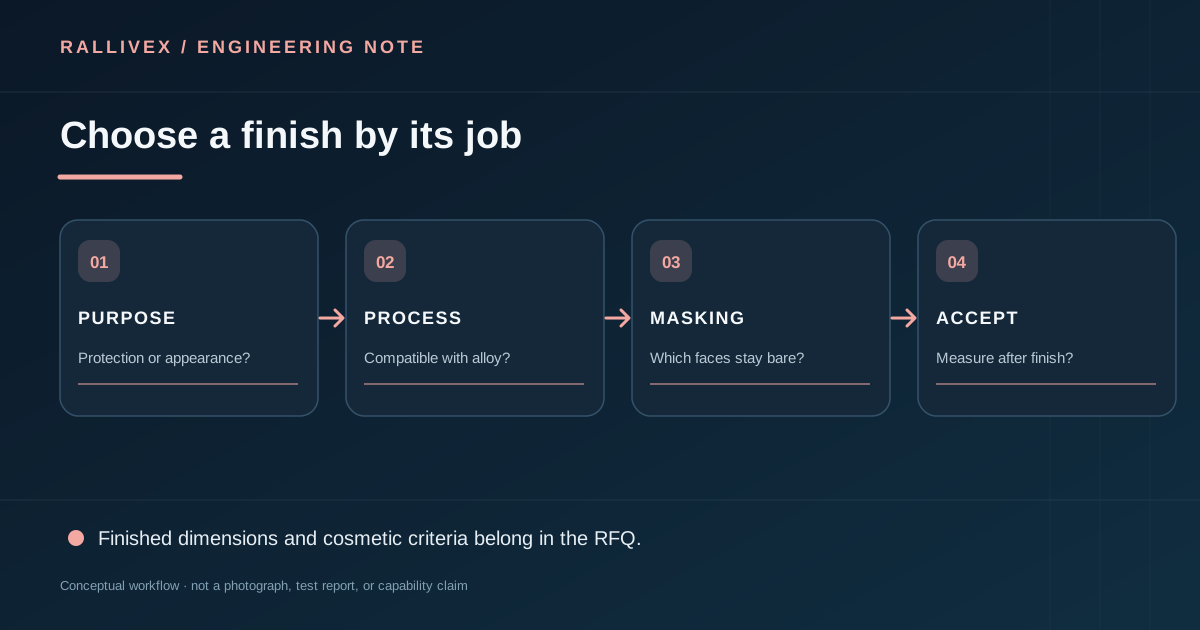
Surface finishing should answer a functional question. Is the goal corrosion protection, a controlled appearance, electrical contact, wear behavior or easy cleaning? “Black finish” is too vague for purchasing because several processes can produce dark parts with different thickness, texture and electrical behavior.
Separate design purpose from process name
An as-machined surface may be sufficient for an internal component, while visible faces may need a defined cosmetic standard. Anodizing creates an oxide layer on aluminum and may be selected for corrosion resistance or appearance; treatment type, color and sealing should be specified with the finishing provider. Conversion coating is often evaluated when electrical continuity matters. Painting or powder coating creates another set of thickness, coverage and masking considerations. None should be treated as interchangeable solely because the parts look similar in a photograph.
Protect critical dimensions
Finishing can alter size, fit and surface appearance. The Aluminum Anodizers Council notes that anodizing-related dimensional change depends on alloy and process conditions and recommends discussing it with the anodizer. Therefore, identify precision bores, threads, contacts and bearing surfaces on the drawing. Say whether they are to be masked, finished and then measured, or machined after finishing if feasible. Specify acceptable cosmetic variation with a physical sample or approved reference when appearance matters.
Make the RFQ testable
Include the alloy and temper, required finish specification, color or appearance reference, critical post-finish dimensions, masking map and any test or certificate requirement. Ask who owns the finish process and how nonconforming appearance will be judged. A finish selected late can change the accepted dimension, so quote it together with machining.
Emerging practice: inspect the coating as part of the part definition
In a connected inspection workflow, the as-machined and finished states are separate versions of the same characteristic, each with its own acceptance criterion. A bore may be checked before treatment for process control and after treatment for final assembly fit. The Aluminum Anodizers Council warns that anodizing dimensions vary with process conditions and alloy; that is why a single generic “growth factor” should not be copied into every drawing. Agree on the finish supplier's input and record the final measurement state in the RFQ.
Next step: send the drawing and marked-up finish areas through request a quote. Material and finishing availability must be confirmed for the specific job.