
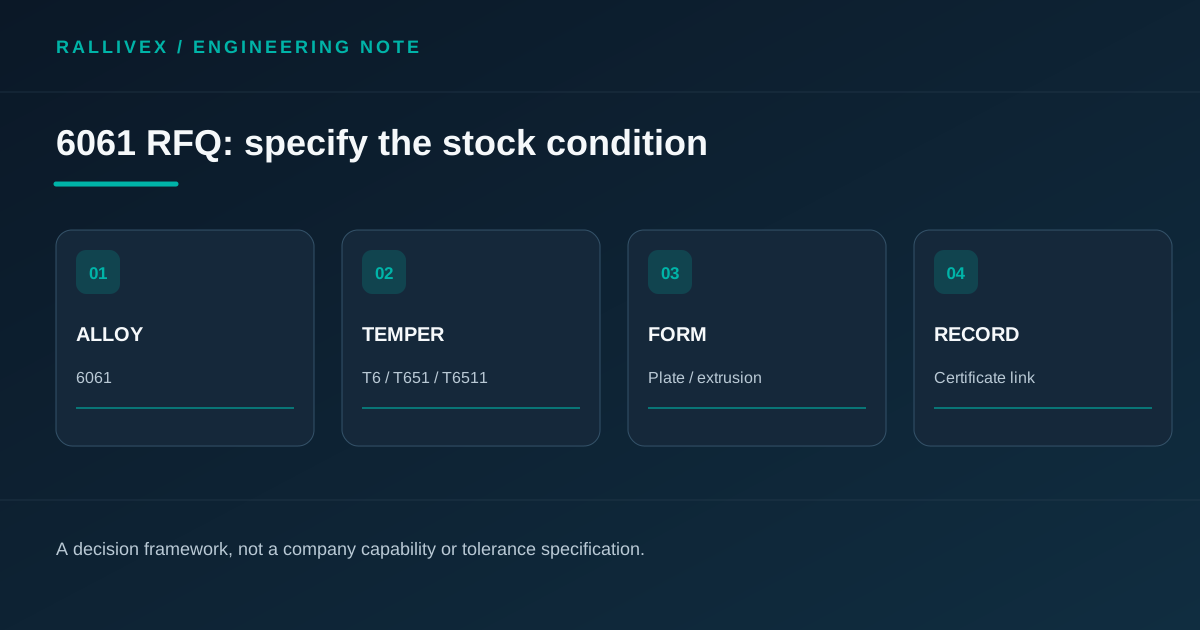
6061 alone is not a material order
The alloy number identifies composition, not the full stock condition. A buyer should state the required temper, product form and governing material specification alongside the part drawing. Plate, rolled sheet, extruded bar and profile are not interchangeable just because each may be sold as 6061. Their available dimensions, processing histories and relevant mechanical-property requirements can differ. A quote for unspecified “6061 billet” may therefore describe a different starting product from the one intended by the designer.
The Aluminum Association explicitly warns that apparently similar temper suffixes can represent different processing parameters and cannot be assumed equivalent. Hydro lists 6061 extrusions in multiple tempers and forms, while Kaiser publishes separate sheet, coil and plate data. These manufacturer documents support an RFQ question, not a single universal property value for all 6061 stock.
Separate T6, T651 and T6511
T6 denotes a solution-heat-treated and artificially aged condition. Additional suffix digits distinguish stress-relief and product-form histories. In the Aluminum Association interpretation, T651 and T6511 are not a casual substitution for one another; T6511 applies to extruded rod, bar, profiles or tube. If the design calculation or customer specification calls for one temper, ask for written engineering approval before a supplier proposes another.
Do not claim that one suffix always prevents movement during machining. Stock stress, part geometry and material removal can still affect distortion. The practical question is whether the chosen stock form and condition match the drawing and whether the supplier can document the delivered batch.
Link the blank to the finished component
Give the supplier the desired blank form and any grain or extrusion direction that controls the design. Identify whether the part is cut from plate, machined from an extrusion or made from another qualified form. If the supplier suggests changing the blank, compare material standard, available size, machining allowance, finish behavior and inspection on the same released design. A new blank strategy should be a documented alternate, not a silent change inside the quotation.
Ask what mill certificate is needed and how the material batch will be linked to the delivered parts. Do not assume every job needs laboratory chemistry testing; define the evidence based on contract and risk. If a product is later anodized, state the coating requirement separately from the base alloy and temper.
Make supplier offers comparable
A useful RFQ line reads: alloy 6061, specified temper and product form, named material standard and revision, blank dimensions or permitted alternatives, and required traceability documents. Add the drawing revision, quantities, finish and critical features. Where a form is flexible, say exactly which alternatives may be quoted and request separate prices or technical exceptions.
This is narrower than asking whether 6061 or 7075 is better. It ensures that two suppliers price the same 6061 starting condition. Once that basis is aligned, the buyer can compare machining, finishing and documentation on a common scope without attributing unverified stock availability or tolerance capability to a website.