
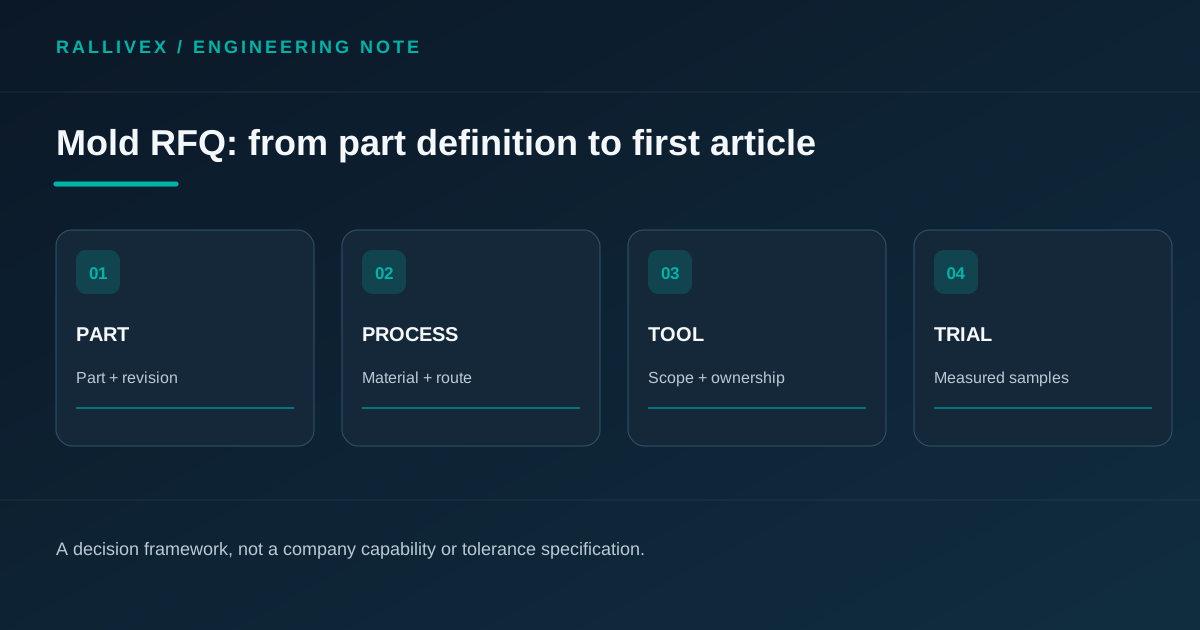
Begin with the part, not a mold photograph
A tool exists to make an accepted part repeatedly. Send a current 3D model and 2D drawing for that part, and identify the revision on both files. Add the material designation, anticipated first order and repeat demand, and the features that control fit, appearance or performance. If any geometry is still negotiable, label it as open rather than presenting it as released.
State the intended manufacturing process. An injection mold, casting mold and stamping die solve different problems, even when they ultimately make similarly shaped components. The former Rally websites describe several tooling and forming routes, but a new RALLIVEX quotation must identify the actual route for your part.
Expose tool-design constraints early
For molded plastic parts, draft, wall thickness, parting, gates and ejection can affect both manufacturability and cosmetic faces. Protolabs' moldability guidance explains why a single draft rule cannot fit every geometry or resin. Autodesk's Moldflow guidance links gate decisions to material, cavity complexity and visible surfaces. Use those topics as review prompts, not as substitute specifications for your supplier.
For casting, the equivalent discussion may include parting, feeding, ejector marks, machining stock and post-cast operations. Put prohibited gate or ejector zones, sealing faces and appearance requirements on the drawing. Where a process simulation is requested, agree its purpose and who reviews its assumptions.
List exactly what the quotation buys
Separate tool design, tool fabrication, trial samples, production parts, secondary machining, finishing and inspection in the RFQ. Ask which revisions, trial rounds and corrections are included. A tool price without the first-article and production scope is difficult to compare with another supplier's offer.
Record ownership, storage, maintenance and the procedure for design changes. These are commercial decisions, not details to infer from a website photograph. If the tooling is customer-owned, establish how its identification and handover will work before release.
Define the first-article decision
Agree the sample count, material and tool condition for trial parts. Identify critical dimensions, appearance criteria, mating tests and any material or inspection records. A first article should answer a documented acceptance question; an attractive sample alone cannot approve an entire production plan.
When trial results require modification, record whether the part drawing changes, the tool changes, or only the process settings change. Keep the revised sample tied to its exact drawing and tool revision so later repeat orders do not unknowingly revert to an earlier state.
A compact package to send
Before requesting a quote, collect the model, drawing, material and process choice; initial and annual quantities; visible and functional surfaces; critical inspection features; trial and approval requirements; and tool ownership terms. If one of these is undecided, state the decision owner and ask for a priced assumption. That produces a reviewable discussion without pretending an unverified tool capacity or lead time is universal.