
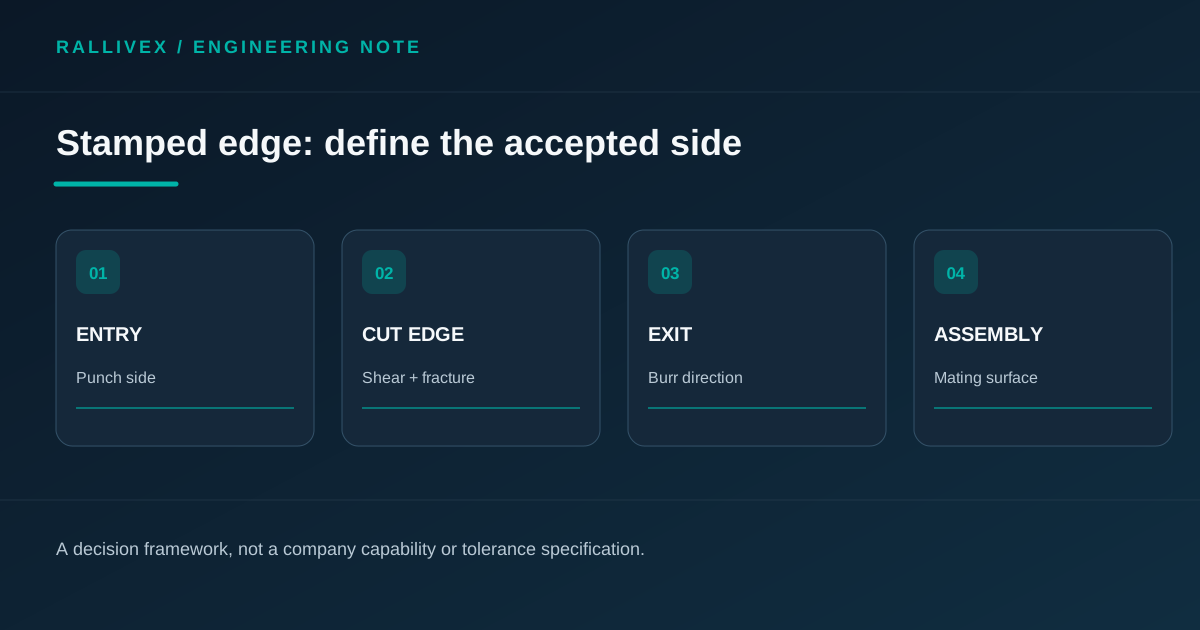
A cut edge has an orientation
A stamped blank is not merely a two-dimensional outline. The punched edge has entry and exit sides and may include rollover, a sheared zone, fracture and a burr. MISUMI's die-basics material explains how punch-to-die clearance influences the cut edge and burr. That makes the edge a design and inspection topic, especially when a bracket slides against another part or a contact must enter a housing.
The direction matters because a burr facing an assembly interface can interfere with seating, scratch a mating surface or create a handling issue. The relevant question is not whether every stamped part has exactly the same edge, but which side and edge condition the finished assembly can accept.
Specify the critical edge on the drawing
Mark the face that should be burr-free or the permitted burr direction relative to a datum and assembly view. If maximum burr height, deburring or edge break is required, state the acceptance method and where it applies. A generic note such as 'remove sharp edges' may be insufficient for a connector contact, sealing feature or sliding surface.
Include the sheet grade, temper and nominal thickness with the flat-pattern or 3D drawing. Material and tool condition influence the process review. Where grain direction or visible faces matter, identify them as well. Avoid asking the supplier to infer those requirements from a photograph of a similar part.
Connect forming and finishing to the edge
A part may be pierced, bent, tapped, machined and coated after blanking. Determine whether burr direction is controlled before or after forming and which side is presented to the mating component. If a coating changes edge appearance or fit, define the finished-part criterion rather than only the raw stamped blank.
Tool wear and process settings can change edge condition over repeated runs. If the edge is safety- or function-critical, agree the sampling and record method for production. Inspection effort should follow the design risk, not a blanket promise that every edge will be identical.
What to ask when comparing quotes
Request the tooling route and any deburring or secondary operation as separate scope items. Compare suppliers on the same material, finish, quantity, packaging and edge acceptance criteria. A lower unit price may reflect a different deburring or inspection assumption, so ask that exceptions be written down.
For a prototype, specify whether it must represent the intended stamped edge or only validate overall fit. A laser-cut or machined sample may support a geometry check but should not be treated automatically as evidence of the final die-produced edge.
RFQ checklist
Send the current model and drawing, sheet specification, quantity forecast, bend and hole geometry, critical mating surfaces, preferred burr side, permitted edge condition, finish and inspection records. If the acceptable burr limit is unknown, identify the mating function and ask for a sample-based decision rather than inventing a number.