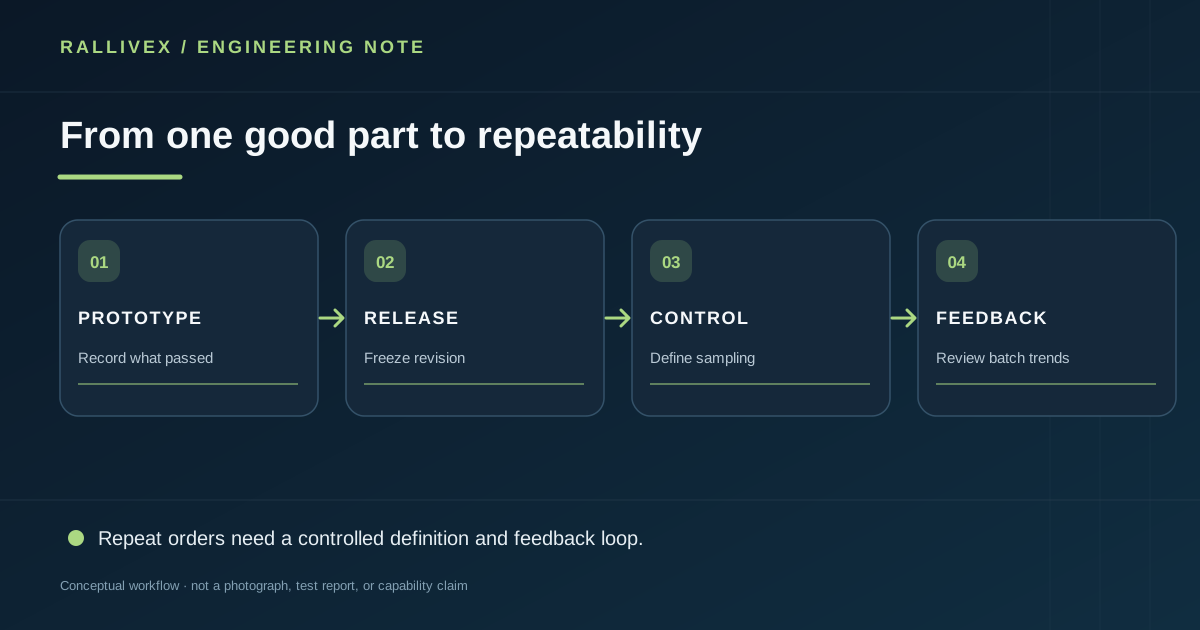
A prototype proves something specific: fit, function, appearance, assembly or a process concept. It does not prove that every later part will match when material batches, setups, finishing suppliers or operators change. Low-volume production needs an agreed definition of the part and a way to detect drift.
Record what the prototype actually validated
If a prototype passed an assembly test, capture the part revision, mating-part revision, material, finish and measured critical features. Separate deliberate deviations from accepted design changes. A prototype with hand fitting or an unrecorded rework step should not silently become the production master. Update the released drawing and bill of materials before requesting repeat orders.
Define the production acceptance plan
Agree which characteristics will be checked on the first run and during repeat batches. State sampling, material documentation, finish acceptance and how changes are approved. The inspection method must be practical for the proposed quantity. If a critical dimension is affected by coating, define the acceptance condition after finishing. Specify packaging for surfaces that matter cosmetically or functionally.
Quote the repeatable route
Prototype pricing may include programming and one-off setup, while production pricing depends on lot size, fixture strategy, cycle time and purchasing. Ask for separate line items where they affect comparison: tooling or fixture, unit price by release quantity, inspection and finishing. Discuss whether the drawing will remain stable across releases. A small design change can reset process assumptions even if the part looks nearly identical.
Emerging practice: use a controlled feedback loop
Connected machine and inspection records can help teams see drift across repeat batches. NIST is researching ways to combine metrology, physics-based models and AI to monitor manufacturing performance; that work is a research direction, not proof that any particular shop can predict defects. Buyers can request a simpler, immediately actionable loop: identify key characteristics, record first-run and repeat-run results against the same revision, review recurring deviations and approve process changes explicitly.
Next step: share the accepted prototype revision, test findings and forecast through request a quote. Ask for a production review instead of merely requesting “the same part again.”