
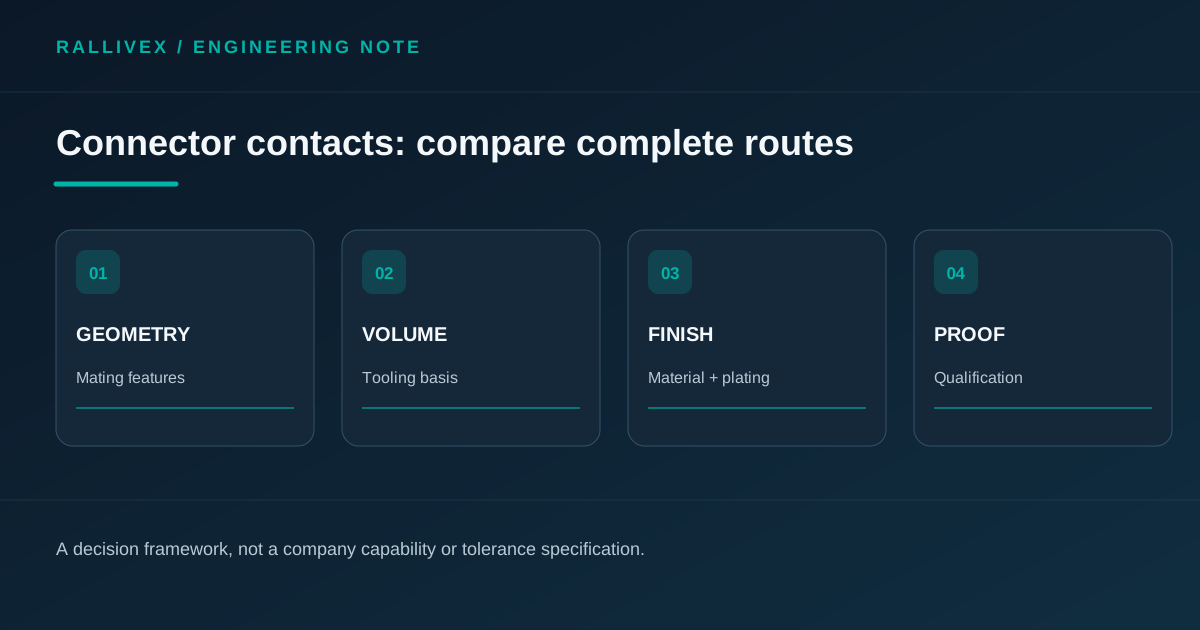
Begin with the contact geometry
A turned pin with rotational shoulders, bores, threads or knurls is naturally considered for machining. A flat or formed terminal can be a candidate for stamping. That is a route-selection starting point, not a rule that one method is always superior. The mating interface, retention feature and termination method may require secondary operations whichever route is chosen.
Provide both halves of the mating pair when possible. Identify insertion and contact regions, attachment features and the dimensions that actually control fit. Electrical performance and service life belong to system qualification; a drawing and process name alone cannot guarantee them.
Separate tooling investment from unit price
Machining can reduce dedicated die investment during design changes or early volumes, while stamping may become attractive when stable geometry and repeat demand justify tooling. The crossover is project-specific. Compare quotations at the same forecast volumes and account for tool ownership, maintenance, scrap, secondary machining and packaging.
If a progressive die is proposed, ask which features are made in-die and which are finished later. Press suppliers such as Komatsu describe progressive, transfer and manual die applications as distinct configurations; the existence of those routes does not prove a particular supplier's press capability. The chosen tooling strategy must be quoted for the actual contact.
Material and plating must be held constant
Base alloy, temper, strip or bar form, and plating system affect both the process and the contact's behavior. Do not compare a machined brass pin with a stamped alternative unless the material and performance requirements are explicitly aligned. State whether an alternate alloy requires design approval.
Specify plating areas, thickness requirements, masked features and dimensions after plating. A gold-colored photograph is not evidence of composition or coating thickness. Ask which records will link the delivered batch to its material and treatment specification.
Qualify the version that will be supplied
A machined prototype can answer assembly questions quickly, but it may not reproduce the edge, grain direction or spring behavior of a later stamped contact. If the route changes after prototype approval, define which fit, force, electrical and durability tests need repeating. Record the mating component and test conditions for any force claim.
Control revisions across part, tooling and plating drawings. For repeat supply, agree inspection sampling, traceability and packaging orientation so the customer can distinguish a stable production process from a one-off good sample.
Decision worksheet
Place geometry, material, initial and annual quantities, tooling ownership, secondary work, plating, critical inspection and qualification tests in one comparison table. Ask both routes to price the same finished-part definition. Choose based on the accepted product and lifecycle economics, not an unsupported tolerance or lead-time promise from a generic web page.